If AI Means Coders Are Now Architects, Do We Need That Many?
In one of our previous tech podcast episodes discussing the pros and cons of using AI in our writing and coding work, Saloni brought up how software engineers were now no longer engineers, but solution architects. A friend of mine who was in the tech education industry had resonated with this shift in paradigm, but at the same time, opened up new discourse which I found interesting.
He mentioned that while he also envisioned tech education shifting in the same paradigm, where learners and graduate profiles shifted from coder to high throughput roles like solution architects and technical product managers, he couldn't help but wonder what this meant for the future of the tech industry.
In particular, he had a penultimate question that bugged him till no end that he wanted to pick my brain on. And BOY did he pick at it! He said:
You might have needed 100 coders in the past, but with this paradigm shift, we're not going to need 100 architects...
He admitted this was more of a question for economists than techies, but I found this to be an incredibly relevant question for the future of the tech industry that should be more than food for thought.
So here's my (admittedly avant-garde) take on this question!
Understanding That The Current State of the Tech Industry
Before going straight to my answer, I want to first provide some pretext on the current state of the tech industry and why it employs the number of software developers it does now.
In truth, big tech are monopolies. Very bloated monopolies that have the power and resources to hire because they can - not because they necessarily need the manpower. You can do a deep dive into their state as big tech monopolies, the attention economy's impact on children in my article right before this: "The Truth of The Undesirable State of the Current Tech Industry".
So with that in mind, here come my answer below.
My Vision for the Future of Tech with AI
My answer is: not if they're all working for the same bloated company. But yes, absolutely, if they're working for 100 different focused companies.
:no_upscale()/cdn.vox-cdn.com/uploads/chorus_asset/file/19211157/obJoP_breaking_up_big_tech_future_competition_2_.png) Image from
Image from AI is fundamentally changing the economics of software development. With tools like GitHub Copilot, ChatGPT, and Claude, a single skilled engineer can now do the work that previously required a team. The bottleneck is no longer writing code - it's knowing what to build and how to architect it.
This shift actually makes the case for breaking up big tech even stronger.
In the old model, you needed large teams because building software was labor-intensive. The coordination overhead was worth it because you needed those 100 engineers. But now, with AI augmentation, you might only need 10 engineers to build the same product. Suddenly, the coordination overhead of a large organization becomes a liability rather than a necessity.
Imagine if instead of one Meta with 67,000 employees trying to do social media, messaging, VR, AR, and AI, we had:
- A focused social networking company with 500 employees
- A messaging company with 200 employees
- A VR company with 300 employees
- An AR company with 300 employees
- Multiple AI research companies, each with 100-200 employees
Each of these companies would need solution architects. Each would need technical leaders who can see the big picture, make architectural decisions, and guide AI-augmented developers. But they'd be lean, focused, and actually solving specific problems rather than drowning in coordination overhead.
The total number of people employed might be lower, yes. But the output would be higher, the innovation would be faster, and the products would be better. And here's the key: those solution architects would have real ownership and impact rather than being cogs in a massive machine.
This isn't just theoretical - we're already seeing it happen. The most exciting products in tech today are being built by small teams using AI tools. Midjourney, one of the leading AI image generation companies, has fewer than 40 employees. Many successful AI startups have teams of 10-20 people building products that compete with offerings from companies with thousands of engineers.
The future of tech isn't 100 architects at one company. It's 100 companies, each with their own architects, each focused on solving one problem really well.
What Does This Mean for Software Engineers?
If you're a software engineer reading this, you might be feeling anxious. "Should I be worried about my job?" The answer is: maybe, if you're planning to stay on the traditional path. But you should be excited if you're willing to think differently.
The shift to AI-augmented development doesn't just mean becoming a solution architect - though that's part of it. It means becoming a product person. An entrepreneur. A builder who captures value directly rather than trading time for money at a big company.
Here's the thing: you now have superpowers that previous generations of engineers could only dream of. With AI tools, you can:
- Build a full-stack application in days that would have taken months
- Design and implement complex systems without a team
- Create beautiful UIs without being a designer
- Write marketing copy without being a copywriter
- Analyze data without being a data scientist
You have all the skills you need to build a product on your own. More importantly, you can now capture value directly from that product rather than building someone else's product and getting a salary while they get rich.
Think about it: in the old model, you'd join a startup, work 80-hour weeks, get paid $150k and some equity that might be worth something someday. The founders and early investors capture most of the value. You're trading your labor for a small slice of the pie.
In the new model, you can build your own product in your spare time, launch it, and capture 100% of the value. You don't need venture capital to hire a team. You don't need to give up equity to co-founders. You can stay lean, stay focused, and build something profitable.
This doesn't mean everyone should quit their job and become a solo founder. But it does mean that the risk-reward calculation has fundamentally changed. The risk of starting something is lower (you can build an MVP in weeks, not months). The potential reward is higher (you own it all). And the opportunity cost is lower (you can do it on the side while keeping your job).
We talk about our perspectives on non-technical founders and what techies can learn from them here!
The engineers who thrive in this new era won't be the ones who are best at writing code - AI is getting better at that every day. They'll be the ones who can:
- Identify real problems worth solving
- Design elegant solutions
- Make smart architectural decisions
- Understand users and markets
- Ship products and iterate quickly
In other words, they'll be product engineers. Solution architects. Technical founders. Not just code monkeys making someone else rich.
Good for Consumers
This shift isn't just good for engineers - it's great for consumers too.
Instead of being forced to use bloated super-apps that try to do everything, we'll have options. Real options. Niche products that do one thing exceptionally well.
:max_bytes(150000):strip_icc()/monopolistic-market-4192732-2-1a0a84322d2041c4b72d5ea41b836147.jpg) Image from https://animalia-life.club/qa/pictures/monopolistic-competition-vs-monopoly
Image from https://animalia-life.club/qa/pictures/monopolistic-competition-vs-monopoly
Want a messaging app? You'll have dozens to choose from, each with different features, privacy models, and design philosophies. Not just WhatsApp, Messenger, and iMessage - all of which are controlled by trillion-dollar companies with their own agendas.
Want a ride-hailing service? You'll have options beyond just Uber and Lyft in US and Grab in Singapore. Maybe one that treats drivers better. Maybe one that's cheaper because it's not subsidizing a dozen other business lines. Maybe one that's focused on sustainability.
Want a social network? You'll have alternatives to Facebook and Instagram that aren't designed to maximize your engagement at the cost of your mental health. Maybe one that's ad-free and subscription-based. Maybe one that's focused on your local community. Maybe one that's built around a specific interest or hobby.
This is already starting to happen. Look at the explosion of niche software products:
- Linear for issue tracking (instead of bloated Jira)
- Notion for notes (instead of trying to use Google Docs for everything. But then again Notion is getting big too)
- Superhuman for email (instead of Gmail)
- Arc for browsing (instead of Chrome)
- Raycast for productivity (instead of Spotlight)
These products are built by small teams, focused on doing one thing really well, and they're winning customers from the big tech incumbents. They're not trying to be everything to everyone. They're trying to be the best at one specific thing for a specific audience.
As AI makes it easier to build software, we'll see an explosion of these focused products. Competition will increase. Innovation will accelerate. And consumers will benefit from having real choices rather than being locked into whatever the monopoly offers.
The future of tech isn't one app that does everything. It's a thousand apps, each doing one thing beautifully.
Current Trends I'm Seeing
This isn't just theoretical speculation - I'm seeing this shift happen in real-time among my peers in the tech industry.
Many of my software engineer friends are starting their own companies. Not venture-backed startups with grand ambitions to become the next unicorn, but sustainable, profitable businesses that solve real problems. They're building SaaS products, development tools, niche marketplaces, and specialized services. They're staying small, staying lean, and staying focused.
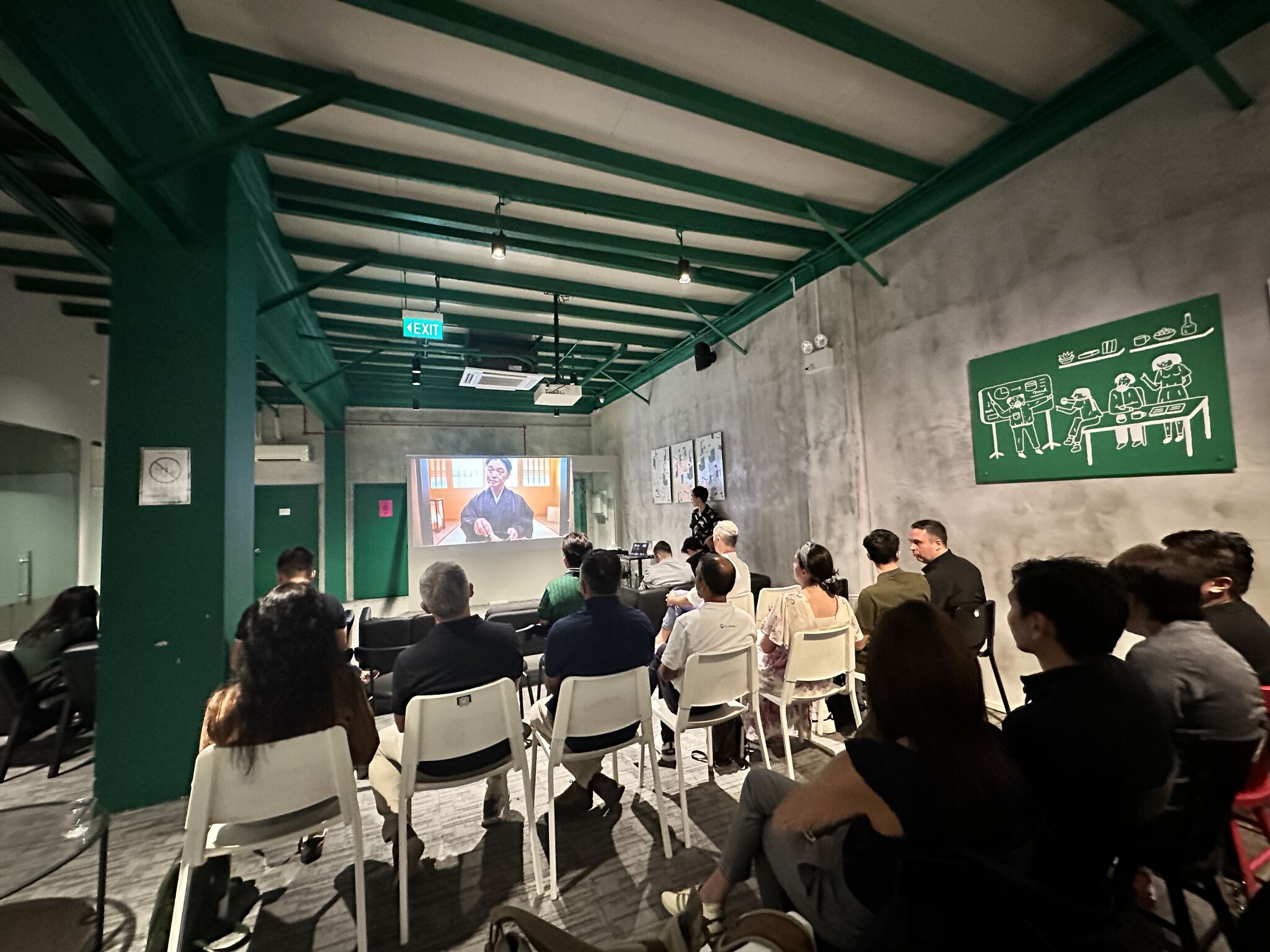
We saw this firsthand at a local startup pitch night where many teams were actively building, iterating, and searching for stronger technical leadership. I wrote more about those observations in Why Finding a CTO is Harder Than You Think.
What's particularly interesting is what's happening with engineers who've been laid off. In previous downturns, laid-off engineers would immediately start applying to other big tech companies. But this time, many are choosing a different path. They're taking their severance packages and using them as runway to build their own products.
Sure, they might take a pay cut, but they also eliminated the stress of corporate politics, the frustration of working on projects that get cancelled, and the feeling of being a replaceable cog in a massive machine.
I'm also seeing a shift in what new graduates want. The prestige of working at FAANG companies is fading. More and more talented engineers are choosing to join small startups or start their own projects rather than grinding through LeetCode problems to get a job at Google.
The tools are enabling this shift. GitHub Copilot, ChatGPT, Claude, Cursor, and other AI coding assistants are making it possible for individual developers to be incredibly productive. No-code and low-code tools are making it easier to build MVPs quickly. Distribution platforms like Product Hunt, Twitter, and Reddit make it possible to reach customers without a marketing team.
Watch our episode on our honest take on vibe coding!
The economics are enabling it too. Cloud infrastructure is cheap. You can build and deploy a product for $20/month. You don't need office space. You don't need to hire a team. You can start small, validate the idea, and scale only if it works.
Most importantly, the mindset is shifting. Engineers are realizing that they don't need permission to build things. They don't need to wait for a company to hire them or a VC to fund them. They can just build.
This is the future I'm excited about. Not one where we need 100 architects at one company, but one where we have 100 companies, each built by engineers who saw a problem and decided to solve it themselves. That's the future where we don't need big tech to be so big - because we'll have thousands of small, focused companies building great products.
The Missing Gaps that Government and Education Need to Fill
But here's where I need to call out a critical blind spot: governments and education institutions are completely missing the point.
Governments around the world are pouring billions into "AI initiatives" and "digital transformation." Singapore has its National AI Strategy. The EU has its AI Act. The U.S. is throwing money at AI research. But they're all focused on the wrong thing - they're investing in AI as a technology, not in AI as an enabler of economic transformation.
What we actually need is infrastructure to enable people to found companies. More startup grants, yes, but more importantly: lower barriers to entry. Simplify business registration. Reduce regulatory overhead for small businesses. Make it easier to hire and fire (controversial, I know, but crucial for small companies). Provide tax incentives for solo founders and micro-businesses, not just for companies that can afford armies of accountants to navigate complex tax codes.
 Image from https://www.singaporecompanyincorporation.sg/blog/13-startup-schemes-and-grants-in-singapore/
Instead, we're making it harder. Want to start a company in most countries? Prepare for months of paperwork, minimum capital requirements, complex tax filings, and regulations designed for enterprises with legal departments. It's absurd that it's easier to build a product that serves millions of users than it is to legally register the business that sells it.
Education institutions are equally guilty of missing the trend. Universities and bootcamps are rushing to introduce AI tools into their curriculums - "Look, we teach with ChatGPT now!" - without fundamentally rethinking what students need to learn.
We don't need to teach students how to write code anymore - AI can do that. We need to teach them how to build products. How to identify problems worth solving. How to talk to users. How to design solutions. How to make architectural decisions. How to ship and iterate. How to market and sell. How to run a sustainable business.
In other words, we need to teach entrepreneurship as a core skill, not as an elective that only business students take. Every computer science student should graduate knowing not just how to code, but how to take an idea from concept to paying customers.
And please, for the love of all that is good, we need to teach ethics.
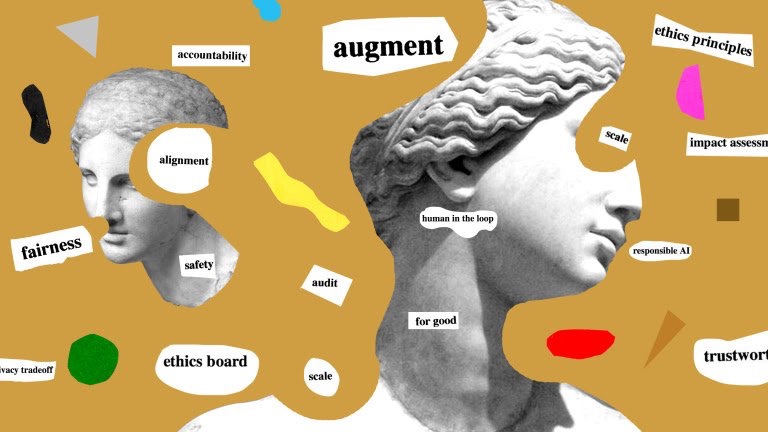 Image from https://healthcarereimagined.net/2021/05/16/big-techs-guide-to-talking-about-ai-ethics/
The Meta researchers who designed features to exploit teenage girls' insecurities? They were trained at top universities. The engineers who built addictive algorithms that prioritize engagement over wellbeing? They learned their craft in our education system. The executives who chose monopolistic practices over fair competition? They're products of our business schools.
We've created a generation of technically brilliant people who never stopped to ask: "Should we build this? What are the consequences? Who gets hurt?"
Ethics shouldn't be a single course you take in first year and forget about. It should be woven into every project, every assignment, every discussion. When you're teaching students to build a social media app, also teach them about addiction, mental health, and platform responsibility. When you're teaching machine learning, also teach them about bias, fairness, and accountability. When you're teaching business strategy, also teach them about stakeholder capitalism and long-term thinking.
The future we're building - one with thousands of small, focused companies - only works if the people building those companies have a moral compass. Otherwise, we'll just end up with a thousand small companies doing unethical things instead of a few big ones.
Governments and education institutions have a crucial role to play in this transition. But they need to stop chasing the shiny object of "AI" and start addressing the fundamental shifts in how value is created and captured in the economy. They need to enable entrepreneurship, teach product thinking, and instill ethics.
Because the tools are already here. The economics are already shifting. The only question is whether our institutions will catch up in time to guide this transformation in a positive direction, or whether they'll keep fighting yesterday's battles while the world moves on without them.
ragTech is a podcast by Natasha Ann Lum, Saloni Kaur, and Victoria Lo where real people talk about real life in tech. Our mission is to simplify technology and make it accessible to everyone. We believe that tech shouldn't be intimidating, it should be fun, engaging, and easy to understand!
✨ragTech Spotify: https://open.spotify.com/show/1KfM9JTWsDQ5QoMYEh489d
✨ragTech YouTube: https://www.youtube.com/@ragTechDev
✨Instagram: https://instagram.com/ragtechdev
✨Other Links: https://linktr.ee/ragtechdev
Recommended Articles

Subscribe to our newsletter!
Read articles from ragTech directly inside your inbox. Subscribe to the newsletter, and don't miss out.