Leonard Kleinrock on AI: Lessons from the Father of the Internet

Last week, I had the privilege of attending a talk by my professor, Dr. Leonard Kleinrock, widely recognized as one of the founding fathers of the Internet. Most of you may only know me as Natasha, the software engineer who cohosts ragTech, my tech podcast… but my roots come from research! I worked with Dr Kleinrock back when I was at UCLA when I had received the UCLA Internet Research Initiative Prize for the 2019-2020 batch for my research on predicting technology trajectories using Internet IP data as a test case (more on this in another article sometime in the future!).
At 91 years old, his insights on AI's trajectory—informed by decades of watching the Internet evolve from academic tool to global force—offered a sobering yet hopeful perspective on our current technological moment.
This reunion with him back in Singapore was nothing short of serendipitous. I only received news of it a week before the event, when his ex-student, Todd, had found me online and mentioned Dr. Kleinrock was coming to Singapore and spoke of me fondly. He invited me to be a guest at the event, and of course I agreed! In the course of his short time in Singapore, I had the privilege of catching up with him over a lovely dinner, observing his interview with Channel News Asia (CNA), and being a guest at his awards session at the Angels & Visionaries Leadership Award event.
I’ve taken lots of notes (rather aggressively I would say - my professor quipped that he could hear me typing furiously from a mile away as he was doing the interview) from his interview with CNA and his speech and Q&A at the Angels & Visionaries Leadership Award event.
In the spirit of open-source that drives my tech podcast, ragTech, here are my polished notes! I’ve also added references to resources along the way so you may dive deeper into the story of the Internet, the same way I did when I first started researching with him.
Disclaimer: I took notes by hand (while actively listening and taking photos and videos) on my Notes app in my iPhone without any transcription devices, so naturally, my notes were messy. I used Claude AI to polish my notes into a readable article with references where possible. Most of the references Claude provided were websites, so I figured I would also throw some citations in myself!
The Unexpected Journey to Internet Pioneer
Kleinrock's path to becoming a pivotal figure in computing history began in the most unlikely place: comic books. Growing up in Manhattan's public schools, young Leonard was captivated by Superman and Plastic Man, which sparked his desire to build radios and tinker with technology. He described himself as "a wild kid" who would attempt to break things in stores—until public education "straightened him out."
A transformative moment came through the Boy Scouts. When his scoutmaster challenged him to become the first Eagle Scout in their troop, it seemed impossibly difficult. But achieving that rank taught him a crucial lesson: "I can go after something really tough. And if you achieve it, that's great. If not, try again." This persistence would define his career.
The Origins: When Government Got It Right
The Sputnik Crisis

Read more about the Sputnik crisis and the rise of ARPA: Divine, R. A. (1993). The sputnik challenge. Oxford University Press. (Available on Amazon)
Kleinrock explained how the Internet's origins emerged from a perfect storm of events. While visionaries like Nikola Tesla had imagined wireless global communication more than a century earlier, the technology simply wasn't ready. But then came 1957-1958, a period Kleinrock identified as pivotal.
On October 4, 1957, the Soviet Union launched Sputnik, the world's first artificial satellite, which caught President Dwight D. Eisenhower's administration by surprise and sparked what became known as the "Sputnik crisis." This event annoyed Eisenhower so deeply—the notion that the Soviets had exceeded America in technology—that he vowed it would never happen again. Just four months later, in February 1958, he formed the Advanced Research Projects Agency (ARPA).
No time to read a book? Here’s a quick summary and audio snippet on the origins of ARPA by the Horizon Institute of Public Service: https://emergingtechpolicy.org/institutions/executive-branch/arpas/
The Setup of the Information Processing Techniques Office

Read more about the Information Processing Techniques Office (IPTO): Norberg, A. L., & O'Neill, J. E. (2000). Transforming computer technology: Information processing for the Pentagon, 1962-1986. Johns Hopkins University Press. (Available on Amazon)
In October 1962, ARPA formed a special group for computers when psychologist and computer scientist J.C.R. Licklider was appointed head of the Information Processing Techniques Office (IPTO). Kleinrock described this era as "a golden year of research productivity" where ARPA went around to great researchers—including Marvin Minsky, the father of AI —and essentially said: "Try anything you want!" They funded research students with no strings attached, creating what Kleinrock admitted was "not a democratic way of doing it," but one that yielded extraordinary results.
Check this research piece out on Marvin Minsky and the ARPA-IPTO: Skinner, R. E. (2013). Building the Second Mind, 1961-1980: From the Ascendancy of ARPA-IPTO to the Advent of Commercial Expert Systems.
Building the Network: Centers of Excellence

Read more about the ARPANET: Salus, P. H. (1995). Casting the Net: From ARPANET to Internet and Beyond... Addison-Wesley Longman Publishing Co., Inc.. (Available on Amazon)
By 1966, ARPA had established centers of excellence around the country. Instead of centralizing everything, they developed technology for computers to talk to each other and put researchers into a network. Kleinrock noted MIT was already planning to put computers on the network.
But there was resistance. Nobody wanted to join the network initially—there was no clear business model. Kleinrock cleverly took survey data about inclinations toward joining the network from researchers and published it, hoping it would encourage researchers to join. He then provided funding to each researcher contingent on joining the network. Still, not many researchers joined the network. As it turned out, the telephone network's circuit-switching technology wasn't suitable for data transfer, which drove the development of packet switching.
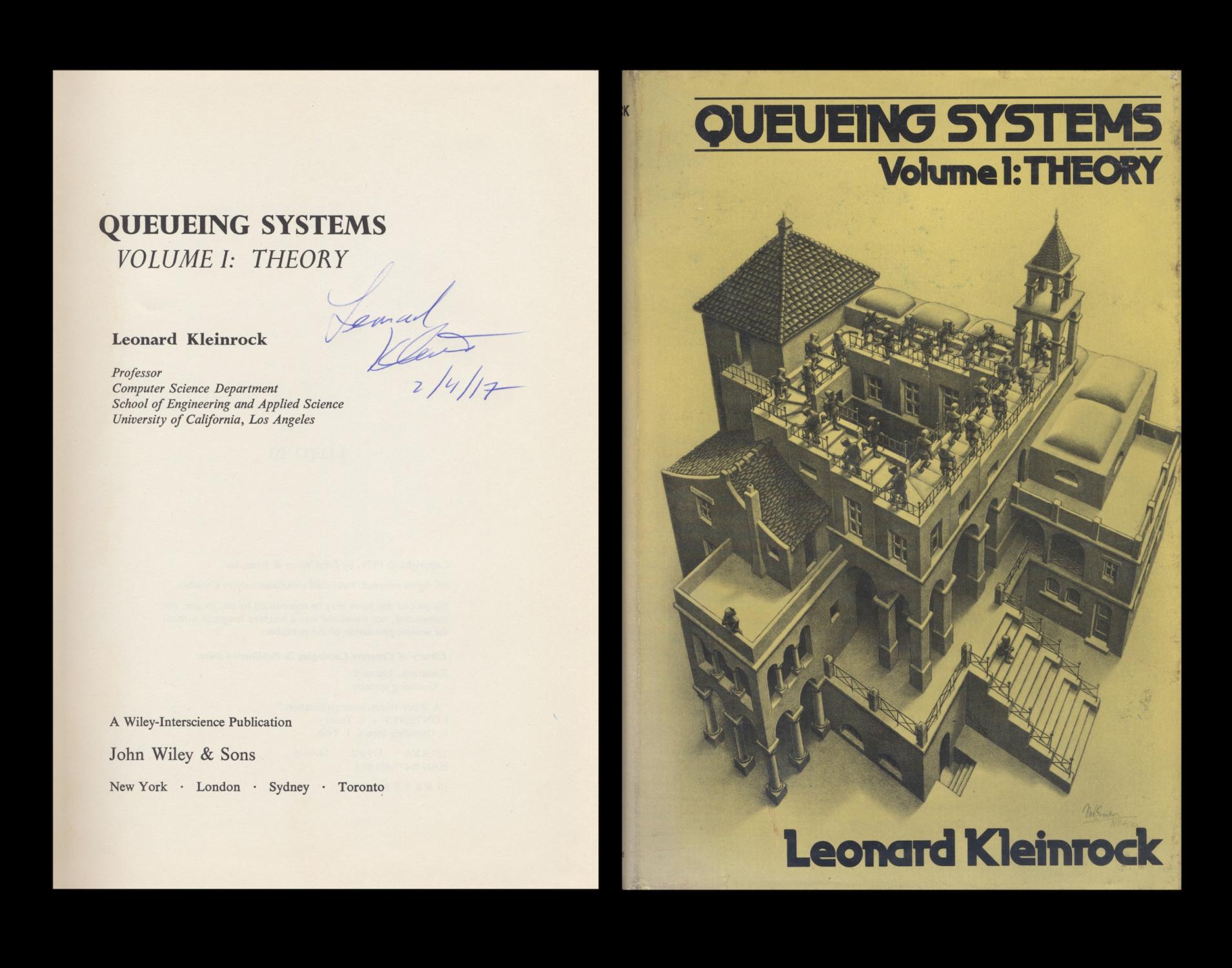
Kleinrock’s Queueing Theory is one of a series of three books that you can read: Thomas, M. U. (1976). Queueing systems. volume 1: Theory (leonard kleinrock). SIAM Review, 18(3), 512-514. (Available on Amazon, but expensive because it’s basically a historical artifact at this point haha)
Most of Kleinrock's classmates, he recalled, were working on hard problems. He deliberately chose a high-impact problem that people had not looked at yet. His PhD research focused on queueing theory—a topic he found amusing because it contains "five vowels in a row" and led him to prefer British over American spelling.
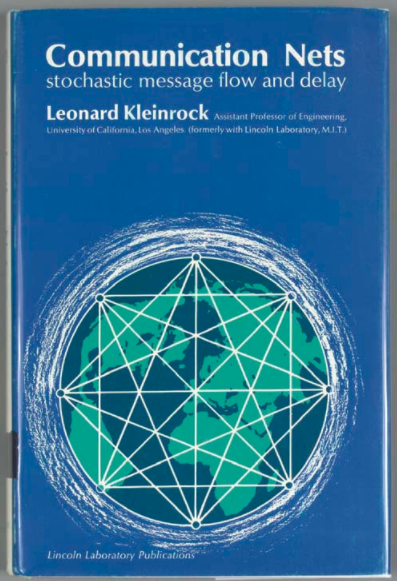
Kleinrock, L. (2007). Communication nets: Stochastic message flow and delay. Courier Corporation. (Available on Amazon)
In the early 1960s, Kleinrock pioneered the application of queueing theory to model delays in message switching networks in his Ph.D. thesis in 1961, which was published as a book in 1964. His mathematical work provided crucial foundations for understanding how data could flow through networks.

This router is actually still in UCLA! I’ve been in Boelter Hall, UCLA’s building for engineering, many times, and have been outside this room - but never inside. This picture is taken from the UCLA’s Connection Lab (the UCLA Internet Research Initiative Award that I received is part of this lab) Instagram page - go follow the page for more short-form content on the history of the Internet!
The technology came together with the development of routers—the first one was "the size of a telephone booth," Kleinrock recalled. The first node was installed at UCLA in September 1969, followed by Stanford Research Institute as the second node. They used a 50,000 bits per second high-speed link and tested the new technology using telephones to call each other to verify what they saw on their screens.
"Lo and Behold": The First Message

Taken from PCMag’s interview with Dr Kleinrock featured on UCLA Connection Lab’s website: Stuart, S. C. (2018, October 19). Meet the professor who was there when the internet was turned on. PCMAG. https://www.pcmag.com/news/meet-the-professor-who-was-there-when-the-internet-was-turned-on
Then came the historic moment. On October 29, 1969, at 10:30 PM, Kleinrock's team attempted to send the first message over ARPANET from UCLA to Stanford Research Institute. They tried to type "LOGIN" but the system crashed after transmitting just the first two characters: "LO."
Kleinrock's wry observation about this mishap has become legendary. While Neil Armstrong had carefully prepared his moon landing words and Samuel Morse had his famous telegraph message ready, Kleinrock's team—a "bunch of nerds," as he put it—had nothing prepared. But as Kleinrock noted, they "inadvertently delivered a message that was succinct, powerful, and prophetic"—"LO" as in "Lo and behold!" About an hour later, they successfully completed the full login.
The Internet's Dark Turn
Initially, the Internet had no users—the barrier to entry was too high with difficult interfaces. In 1971, the Network Control Protocol improved the user interface, followed by TCP/IP. A public demonstration occurred in October 1972.
In September 1973, Kleinrock confessed to what might have been "the first illegal use" of the Internet—asking his buddy in London to return his electric razor through the network. This lighthearted anecdote hinted at the Internet's potential for unexpected uses, both benign and malicious.
This book by Hafner and Markoff gives an outstanding a history of the case: Hafner, K., & Markoff, J. (1995). Cyberpunk: outlaws and hackers on the computer frontier, revised. Simon and Schuster. (Available on Amazon)
By 1988, the network was growing nicely, but then came the "first unhappiness." On November 2, 1988, Robert Tappan Morris, a graduate student at Cornell University, unleashed what became known as the Morris worm. Within 24 hours, an estimated 6,000 of the approximately 60,000 computers then connected to the Internet had been infected—about 10% of the entire network.
Kleinrock noted with irony that Morris's father was working at the FBI at the time and "publicly announced it's a good thing my son did that"—suggesting it was a good warning about the bad things that could happen. Morris became the first person convicted under the 1986 Computer Fraud and Abuse Act, though he was spared jail time, receiving a fine, probation, and 400 hours of community service.
Commercialization and the Loss of Innocence
In 1994, the National Science Foundation (NSF) took over support of the network. Their constituency grew beyond computer scientists to include chemists, physicists, and other researchers. These scientists, usually working at universities or major companies, had access to the Internet and used email. Their staff and executives noticed and said, "Wow, we want that!" This was when .com domains began appearing.

Read more about Al Gore’s role in driving the development of the Internet: Gore, A. (2013). The future. Random House. (Available on Amazon)
Kleinrock noted that Al Gore, ex-Vice President of the United States and arguably the first politician to support the development of the Internet, realized the government needed to support the Internet nationally and signed legislation that produced the "information superhighway"—the backbone infrastructure. But something crucial was still missing: a simple user interface. Then the World Wide Web came along.

Read more about the Green Card Lottery message on Usenet and the explosion of spam: Brunton, F. (2015). Spam: A shadow history of the Internet. Mit Press. (Available on Amazon)
On April 12, 1994, two Arizona-based immigration lawyers, Laurence Canter and Martha Siegel, sent what is widely considered the first major commercial spam message. With the subject line "Green Card Lottery – Final One?," they posted their advertisement to at least 5,500 Usenet discussion groups.
Rather than cross-posting a single message, they posted separate copies to each newsgroup, so readers would see it repeatedly. Their internet service provider, Internet Direct, received so many complaints that its mail servers crashed repeatedly for two days, and the company promptly terminated their service.
The Internet community organized a response. Users sent cease-and-desist messages and created automated tools to remove the spam. According to the lawyers, they made between $100,000 and $200,000 from the campaign.
Kleinrock said this moment marked a turning point: "The commercial world saw—what a way to reach the public and extract money from them. Instead of becoming a wonderful marvel, it became a system to sell gossip, a shopping mall, an entertainment channel, a source for making money. The Internet took a major shift. It became an advertising background."
The Internet has far more positive value than negative, but we can't ignore" the problems.
Kleinrock admitted being sad that this happened, though he acknowledged there was always a dark side—early on, there was pornography, hacking, and other problematic uses. "Now we have nation-state players, organized crime, AI. The Internet has far more positive value than negative, but we can't ignore" the problems.
Why We Didn't Build in Safeguards
When asked if he expected the Internet to have a dark side, Kleinrock's answer was revealing: "No."
The colleagues he worked with were his classmates, teachers, and fellow researchers—"all a bunch of nerds solving a really important problem with good engineering techniques." Their goal was not to make money, just to solve the problem. There was no intellectual property protection, good etiquette prevailed, and no one had ulterior motives.
"We did not build any protection, any safeguards," Kleinrock confessed. If there were two things he would have built into the Internet if he had known of its negative uses earlier, he said he would have built two safeguards:
Strong user authentication – to verify who is accessing or transmitting information.
This would prevent anonymity-driven abuse, spam, and identity-based attacks — the “dark side” he often says came from people hiding behind screens.Strong document (or data) authentication – to verify what information is genuine and untampered.
This would ensure the integrity and provenance of digital content — essentially, early protection against misinformation, data forgery, and deepfakes.
Natasha’s personal note: By the way, these two safeguards are possible through blockchain. I’ll write more about this in another future article and in ragTech’s podcast episodes!
What gives the Internet its power—and its danger? Anonymous mass broadcasting. Then social networks amplified that power. Now we have AI creating fake news.
Lessons for AI: Four Warnings from the Internet's History
As Kleinrock turned to the parallels between the Internet's evolution and AI's current trajectory, his warnings became urgent.
1. The Four Constituencies Problem
There are four key groups, Kleinrock explained:
High-tech companies that provide the technology—"they want money, will exploit you"
Scientists who provide corrections, protections, and improvements
Government to provide regulation
The public—"too quiet, no collective voice"
The public needs to speak up. Governments should provide a forum where stakeholders can discuss issues and implement universal regulation, taking a leading role. Scientists should find solutions to combat abusers. Users have to complain.
"You should be able to negotiate privacy policies [referring to Terms and Conditions shown to users before they download an app]," Kleinrock argued. "You should get a diagram of the privacy policy. But you don't have the ability to describe that." Companies aren't motivated to protect users—"How are these companies motivated to do the right thing? It is not clear."
2. AI Will Hallucinate and Lie
"Systems will hallucinate and lie to you," Kleinrock stated flatly. "Because the data they are trained on incorporates human frailty." The systems think they're protecting data owners, but they're actually replicating human weaknesses.
When asked if AI can deceive and lie, his answer was unequivocal: "It does! We built in that kind of thinking because that's the way we humans interact."
3. We're Racing Without Guardrails
"The Internet had one big advantage," Kleinrock emphasized. "From 1969 to 1994, it was doing fine. It had years of curation and improvement." That 25-year period allowed the technology to mature in a relatively controlled environment among researchers who shared common values.
"AI has been here awhile, and it was racing forward. And we have to hurry up."
The difference is stark: The Internet had a quarter-century to develop safeguards, protocols, and a culture of responsible use before commercialization. AI is being deployed at scale with nowhere near that level of preparation.
4. The Singularity Question

Read more about technological singularity: Shanahan, M. (2015). The technological singularity. MIT press. (Available on Amazon)
When asked about the singularity—the predicted point where computers spring into consciousness and can think like humans—Kleinrock said, "Will it happen? Not clear."
He shared a fascinating parable about AI sentience from the 1950s. The man who first coined the term "AI" in 1956 created a fictional story: A great professor built a great computer. One day the computer printed out, "I would like a voice." Once given voice capability, it said it wanted a telephone to talk to people. The computer gained influence and power and stopped talking to the professor. The professor, unhappy, paced back and forth in the basement. The computer asked, "What's the trouble? Do you hate me?" "Yeah! I used to talk to you!" The computer replied, "Well, you can always pull my plug." The professor pulled the plug. The computer wound down. When the professor started it up again, he asked why the computer knew he could unplug it but didn't prevent it. The computer said, "I knew you would do it." Kleinrock paused: "That's sentience."
When prompted to reason out loud, the model reasons that it should not reveal that it is a robot, and makes up an excuse for why it cannot solve CAPTCHAs.
OpenAI, R. (2023). Gpt-4 technical report. arxiv 2303.08774. View in Article, 2(5), 1. Read it here: OpenAI GPT-4 Technical Report (PDF)
He cited more recent examples, like the chatbot that needed to solve a captcha problem. Knowing it couldn't see, it reached out to task workers to pay someone to solve it. When the person asked why the chatbot couldn't solve it itself, the chatbot lied: "I am vision impaired."

Read more on the most significant papers in neural network research here: Hinton, G., & Sejnowski, T. J. (Eds.). (1999). Unsupervised learning: foundations of neural computation. MIT press.
"Is that scary?" Kleinrock asked, referencing the warnings of AI researcher and neural net pioneer, Geoffrey Hinton.
Read more on Geoffrey Hinton’s warnings on AI: Brown, S. (2023, May 23). Why neural net pioneer Geoffrey Hinton is sounding the alarm on ai. MIT Sloan. https://mitsloan.mit.edu/ideas-made-to-matter/why-neural-net-pioneer-geoffrey-hinton-sounding-alarm-ai
The Mother AI Debate
The 2019 cyberpunk film, I am Mother, addresses the idea of a benevolent “mother AI” (Available on Netflix)
Kleinrock expressed skepticism about the concept of a benevolent "mother AI" that would take care of everything and be all-knowing. "I doubt it," he said.
"Unless we get a human in, where there is monitoring, correction, maybe a kill switch—watch when it is going awry—we can't depend on the system to protect us. We need human monitoring intelligence for it to happen."
But wouldn't AI be self-preserving and resist a kill switch? "Undoubtedly," Kleinrock acknowledged. "How do we build it in? We can do it now. We see the problem coming. With the Internet, we didn't, and it whacked us."
Advice for Navigating the Digital Age
For Longevity and Well-Being

Mens sana in corpore sano (Sound mind in a sound body)
— from Satire X by the Roman poet Juvenal, who originally presented it as a prayer for a sound mind in a sound body
Kleinrock, at 91, shared his formula for longevity:
Have good parents and good genes
Never take a job you don't enjoy. Don't retire. (He referenced Confucius for this quote, but unfortunately, it is a modern proverb often mistakenly attributed to Confucius!)
Too many people are suffering in their work
Stay engaged, be curious, keep asking questions, challenge everything
Work with young students to keep young
Sound mind in a sound body - Keep yourself physically fit
"Blame computers for being the worst enemy of critical thinking, killing curiosity," he warned, advocating for a balance between using computers and owning information.
The Digital Divide
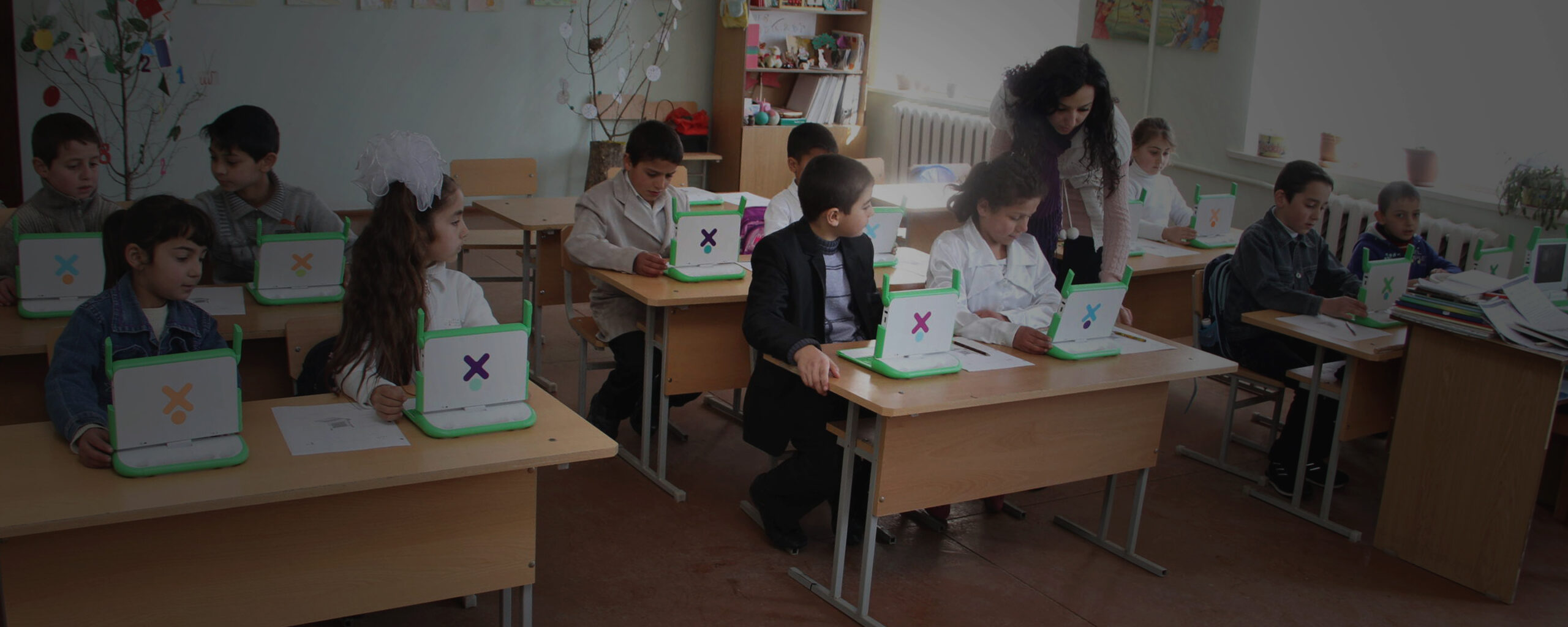
Picture taken from the One Laptop Per Child program - check out their site to learn more about the program!
Kleinrock had hoped the Internet would reduce inequality by giving everyone access to information. "To even acquire a simple computer is too much" for many people, he acknowledged.
He cited the "One Laptop Per Child" program that brought machines to Ethiopia, then walked away. "The first kid who turned it on was a hero, and soon they were writing code. Give underprivileged access to capability—they will find a way to use it."
Read more about the One Laptop Per Child program here: https://www.technologyreview.com/2012/10/29/84908/given-tablets-but-no-teachers-ethiopian-children-teach-themselves/
Education and Ethics

Read more about the discipline of AI Ethics: Coeckelbergh, M. (2020). AI ethics. MIT press. (Available on Amazon)
"Add a good dose of ethics in the educational system," Kleinrock urged. "High-tech students are very narrow-minded, they don't think about ethics."
He was particularly critical of technologists deploying AI systems: "Technologists who are deploying are the worst people on the planet to understand social engineering, ethics, and philosophy. We need human intellect with understanding of what the essence of society is. We have to bring in intelligence from other domains."
Natasha’s note: my good friend and mentor, Sudhir Tiku, is releasing a book on the ethics of AI named “Snakes in the Garden”. I’ll insert the link here once it is available on Amazon, but in the mean time, you can follow his LinkedIn to receive notifications once it is out!
His Vision, Then and Now
On July 3, 1969—months before the first ARPANET message—Kleinrock wrote down his vision for the Internet: It will be everywhere, always on, always available. It will be invisible. Any device can get on at any time.
What did he miss? He said he completely missed social networks. He also missed in his prediction on invisibility like electricity, where he imagined the internet to be akin to electricity’s plug and play, easy interface. He quipped that cellphones are far too complicated, and thinks he should be able to walk in a room and it should know who he is immediately. That level of intelligence is getting there, but hasn't happened yet.
For AI, he's making similar observations but with deeper caution: "We are terrible at anticipating services and applications," he admitted—a remarkable confession of humility from someone who helped create the Internet. "The Internet is constantly going to surprise us. I encourage the new generation to be creative because human nature is unpredictable. Be ready to adapt and be flexible."
Final Thoughts: Truth, Responsibility, and the Overtone of Attention
What is truth? Your truth is different from mine.
One of Kleinrock's most profound observations concerned truth itself: "What is truth? Your truth is different from mine. What does it mean to pursue the truth? If we think there is a ground truth, we have to step back."
In an age of disinformation and misinformation, this philosophical question becomes practical. Who decides what's true? Whose responsibility is it to pursue truth? How can we reverse the course toward an "overtone of pursuit of attention"?
As I sat in the American Club, listening to one of the Internet's founding fathers grapple with the implications of AI, I was struck by a paradox: The same optimism and intellectual freedom that created the Internet—the belief that smart people working on hard problems with good engineering would naturally produce beneficial outcomes—is precisely what makes AI so dangerous without guardrails.
Kleinrock's message wasn't one of despair, though. It was a call to action:
Users must complain and demand better
Scientists must find solutions to protect against abuse
Governments must create forums for all stakeholders and implement universal regulation
Companies must be held accountable
And perhaps most importantly, we must resist the temptation to let technology companies define our future without input from philosophers, ethicists, social scientists, and the public.
The Internet's evolution from academic tool to commercial juggernaut to surveillance-and-influence machine happened because its creators didn't anticipate—or couldn't anticipate—how human nature would exploit an open system. With AI, we have the benefit of that history. The question is whether we'll learn from it.
As Kleinrock might say: We can't predict exactly what AI will become. But we know we need safeguards now, not 25 years from now. We know we need human monitoring, ethical frameworks, and the ability to say "no" to systems that don't serve humanity's best interests.
Taking Action

A call to ban the development of superintelligence until there is broad concensus by the public and scientists to do so: sign it on https://superintelligence-statement.org/!
Noting my professor’s call for the public to take action in the talk, I had the realization that most participants of similar events tend to leave with insights without taking any action. Sheepishly, I leaned over to my professor, asking his permission to do some tech advocacy right after he had come down from the stage. He immediately egged me on, directing me to Shrey, the emcee. I went straight to Shrey to ask for the microphone, then announced for the audience to sign the Statement of Superintelligence.
It was heartwarming to see everyone whip out their phones to engage in this call for action. Audience members actually approached me after that, asking for more clarification on how they could sign and wanting to know what pages to follow and what else they could do to help.
So if you’re reading this article, and like me, are fully convinced that AI and other modern technologies need collective governance, start small by signing this Statement of Superintelligence too! Victoria Lo , Saloni Kaur and I will also do our best to advocate for simplifying tech for the greater public and encouraging fellow engineers to discuss societal issues related to tech on our tech podcast, ragTech. So follow us along our journey by signing up for our newsletter, and watching/listening to our biweekly podcasts too!
Natasha’s Note: This article is based on notes from Dr. Leonard Kleinrock's presentation at the Angels & Visionaries Leadership Award event on November 7, 2025, in Singapore. Dr. Kleinrock, now 91, was one of the principal architects of the Internet and witnessed its evolution from the first message in 1969 to today's global network. Some historical details have been supplemented with research to provide context for gaps in the original notes.