1984 In The Age of AI
This article contains an affiliate link. We earn commissions when you shop through the link below, at no additional cost to you.
After an addictive period of heavy, mindless and soul-sucking doomscrolling (I would blame the stint of stomach flu I had last week but I know it's my self-restraint that is the issue, not my immunity), I've recently resolved (yet again) to read more. I finally made decisive action to purchase books I have had on hold in my imaginary reading list. Why physical books? Well, thing is, I've had them in various ebook formats in my phone for awhile and have been reading a smattering of pages here and there, but the draw of the incessant notifications on my phone was too much of a distraction to continue reading.
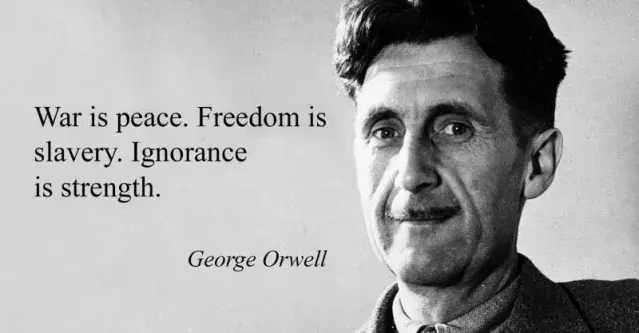
So yes, I ordered physical books my way and one of them was George Orwell's 1984, a classic I've been hinted at countless times to read especially as a someone who shares her critique on technology and its effects on society. It also seemed apt to pick up a book on technological totalitarianism during a time where I was resolved to wean off the addictive and mind-numbing pull of social media, so I started on it with much excitement but admittedly also with some dread that I might have to fight against my own devils to stay through and finish the book instead of skimming.
I'm happy to say that I absolutely devoured this book in a single weekend. It is no wonder the book is a classic - Orwell's intricate and well thought-out design of a dystopian surveillance state and its flawed, satirical citizens (including the main protagonist) is as much gripping as it is...apt. So timely, and so apt for the era of AI that we live in today. Many times in the book it spelt out exactly the themes I have been mulling about pertaining to the state of our current society (vis-a-vis technology) and unable to use words to describe.
In an instance of what felt like book-Inception, the main protagonist talks about how he reads a book revealing the truth about his society, and realized it "had not actually told him anything that he did not know; it had merely systematized the knowledge that he possessed already" (1984, pg 217). That was exactly the reassuring epiphany I had as I read 1984.
What 1984 systematized for me is what I want to spend the rest of this series trying to articulate: that the promise of AI lifting us out of poverty and disease cannot coexist with the structures that currently govern our world.
I wanted to dive into the very many parallels of the themes of 1984 and how it relates, or some would say eerily predicts (in a fate of cruel irony), the current state of society we live in vis-a-vis AI. In this article I'll touch on the first one that struck me the most, specifically on The Need for Perpetual Warfare Aided by AI. I'll follow up with links to the other themes I have in mind when I have them, but for now they are rough names: The Loss of Independent Thought, The Reduction of Language, Internal Governance and Surveillance, Truth is Not Fact... But What is Fabricated.
The Need for Perpetual Warfare Aided by AI
The primary aim of modern warfare is to use up the products of the machine without raising the general standard of living. (1984)
Why do Wars Happen?
I've constantly asked myself the question, "Why do wars happen?" as I scroll and read article and reel after article and reel of a country stricken by war. It's devastating, it is cruel, it is unnecessary. I thought that diving deeper into the history of a particular war would provide some answer, but no, the trigger of many wars in my opinion is often merely the fragility of ego of a few. I've never had satisfying language for what happens next, for how that ego scales from one person's pettiness into something that engulfs millions of lives. 1984 gave me that language.
Then came AI in 2023, supposedly this beacon of hope for a fertile, fruitful future of democratized knowledge and resources. Nobody has to starve! Everybody will be literate! All diseases will be cured in time! Nobody will have to work and slave! Behold the power of AI!
But come 2026, nothing has changed. In fact, things have worsened.
Hate has intensified. Wars have expanded. Slavery has taken a new form in the shape of manual labour for the AI machine. The thousands of workers in Kenya, the Philippines, and Venezuela being paid as little as $1.32 an hour to label images and moderate violent content are the invisible backbone of the AI systems we use every day.
Watch our tech podcast's most recent episode on How AI is the New Colonialism
AI at The Heart of Modern Warfare
And worse, AI is at the heart of warfare now. Just look at Trump's Directive on AI in the National Security Enterprise. AI systems are being leveraged upon to advance America's wars, and the few AI companies there are are fighting over securing defense contracts. 8 big tech companies have secured defense contracts with Pentagon so far specifically for the use of AI tools in their internal networks. Palantir is one such company (in)famously known to tout technological totalitarian values, including insinuating certain cultures are inferior and advocating AI state surveillance of citizens in its 22-point manifesto.
In CEO Alex Karp's own framing, the government is entitled to scrutinize personal life down to every purchase, message, location, and transaction. The manifesto openly asserts that certain cultures remain "dysfunctional and regressive," and Palantir's surveillance technology is now embedded throughout the US government, from the White House to defence and immigration agencies. Did I mention its logo is inspired the 'seeing stone' from the Lord of the Rings and literally looks like an eye? Heck, last year the US had the 'Big Beautiful Bill Act' which included a large sum of money for the Pentagon to spend on AI and offensive cyber operations. They've even renamed the Department of Defense to the Department of War. Oceania in 1984 had a Ministry of Peace that waged war and a Ministry of Truth that falsified history. I'm not sure Orwell expected the mirroring to be quite this literal.
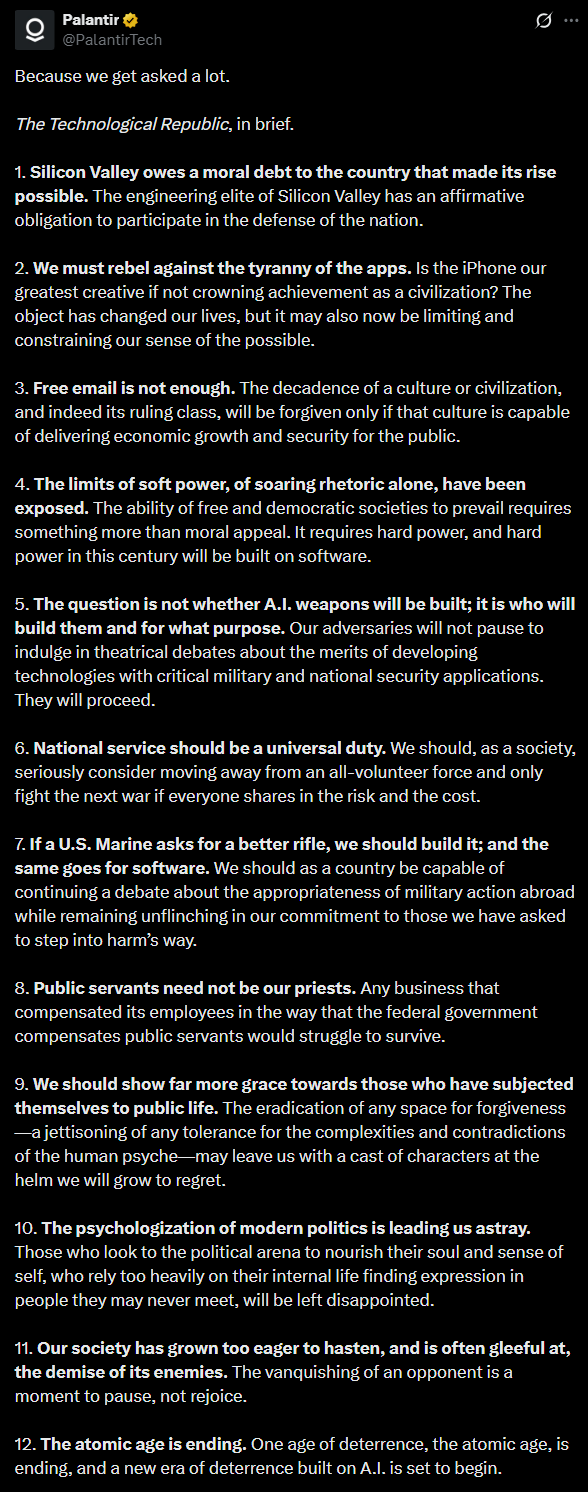
Tell me these real-life updates don't sound like they could belong in excerpts from 1984??
Doesn't the Big Beautiful Bill sound like something Big Brother would come up with?
Reading 1984, it finally made sense to me why technological progress and war come hand in hand in certain societies.
War is Peace
War is peace, espouses one of the grand slogans of The Party in 1984. What this actually means is that war is necessary for a hierarchical society where only a handful wield power to be perpetually stable.
The perpetual state of war serves more than one purpose for the Party.
It is one, a distraction for the people. In our own historical context, this has always been at the heart of Nationalism, an ideology that puts a nation above all other needs surpassing that of an individual and/or a group (also an ideology often attributed to the start of our world wars). Part of driving nationalism is a political strategy of focusing energies on an outsider so internal strife is forgotten. This is exactly what happens in 1984, where the focus on the wars that Oceania is fighting distracts the people from the inequalities of their world. This is also very similar to what is being said about the current wars that the US is engaged in, for example how Trump wants to distract Americans from scandals at home with a diversionary war.

War also justifies control over the masses of the people. It empowers the Party in 1984 to employ the Thought Police, the telescreen for surveillance, all under the 'noble' cause of protecting against covert outsiders in their society. The key difference AI introduces is scale: Orwell's telescreen could watch you. AI can predict what you are about to do and act on that prediction before you even do it. Not so much just AI, but also extending to social media, this theme was also largely surfaced in the US's fight over banning Tiktok, the popular social media app owned by Chinese company, ByteDance. Their main justification for this was for national security reasons. Officially known as the Protecting Americans from Foreign Adversary Controlled Applications Act, the ban was enforced in January 2025 amid long-time fears that the Chinese government could access user data. Ironically, this in turn led US investors to take control of the app and its users data starting January 2026. There has been some speculation online that since the takeover, there has been some level of political censorship of content on the app, but this remains to be concretely proven.
This is the telescreen logic of 1984 in motion. Whether the concern about foreign surveillance was legitimate or not, the outcome is the same: the data is now in the hands of US investors and the government's allies have access to it. The screen stayed on.
And lastly, war is justification for economic control over resources, to allow the Party to do whatever they deem fit. Just look at how the Trump administration has asked for a $1.5 trillion defence budget for next year – a 42 percent increase, or the largest expansion in military spending since World War II. That same budgetary allowance asked for could have been asked to subsidize healthcare, or to help citizens pad for inflation - but no, winning the war is more important.
![US Defense Secretary Pete Hegseth walks to attend a House Armed Services Committee hearing on the Department of Defense’s FY27 budget request, on Capitol Hill in Washington, DC, April 29, 2026 [Elizabeth Frantz/Reuters]](https://www.aljazeera.com/wp-content/uploads/2026/04/2026-04-29T142520Z_1489075864_RC22ZKAFBME0_RTRMADP_3_IRAN-CRISIS-USA-CONGRESS-1777473222.jpg?w=770&resize=770%2C513&quality=80)
Increase in Wealth by AI Threatens Society
But it was also clear that an all-round increase in wealth threatened the destruction – indeed, in some sense was the destruction – of a hierarchical society.
1984 hypothesizes that warfare is the only way to channel surplus created by 'the machine' towards an outlet without raising the general standard of living of the peoples, and in essence, without solving inequality. Because inequality is needed for the few in power to retain their power.
But in practice, such a society could not long remain stable. For if leisure and security were enjoyed by all alike, the great mass of human beings who are normally stupefied by poverty would become literate and would learn to think for themselves; and when once they had done this, they would sooner or later realize that the privileged minority had no function, and they would sweep it away.
Basically, if we were to reap the benefits that the owners of AI so readily promise to give, that of curing cancer, removing the need to work, having bounds of economic prosperity, and democratize knowledge - this might mean that AI would erase struggle and inequality in the common people, as well as increase their literacy and knowledge. Then there may come a point that they realize the handful of those in power and hoarding wealth are unscrupulous and unnecessary for society to function, potentially causing them to be overthrown.
But when you throw warfare in the picture, that's when the scale is tipped. With warfare, the benefits reaped from AI are funnelled into warfare. For example, this can be seen in how the US economy expanded 2% on AI spending surge amid Iran war, but inflation edges up to 3.2%. The 2% economic benefits from AI do not go back to the people - they get funnelled out to subsidize warfare. That is why we, we common people, do not reap tangible benefit from the AI machine. Because if we do directly benefit, it threatens the concentration of power and wealth at the top and might incite us to rebel - or so as 1984 suggests.
And this is the part that I'm still mulling on. The technology is definitely capable of what they promised - despite my constant criticism of AI, I am optimistic about what it can bring for society IF used correctly. Curing disease. Democratizing knowledge. What 1984 helped me understand is that capability is not the bottleneck. Those who hold power have every structural reason to funnel the benefits of AI away from us, because doing so keeps things exactly as they are. So instead, it gets poured into a war. And we are told to be grateful for 2% economic growth... but how come we are still suffering?
ragTech is a podcast by Natasha Ann Lum, Saloni Kaur, and Victoria Lo where real people talk about real life in tech. Our mission is to simplify technology and make it accessible to everyone. We believe that tech shouldn't be intimidating, it should be fun, engaging, and easy to understand!
✨ragTech Spotify: https://open.spotify.com/show/1KfM9JTWsDQ5QoMYEh489d
✨ragTech YouTube: https://www.youtube.com/@ragTechDev
✨Instagram: https://instagram.com/ragtechdev
✨Other Links: https://linktr.ee/ragtechdev
Recommended Articles
Subscribe to our newsletter!
Read articles from ragTech directly inside your inbox. Subscribe to the newsletter, and don't miss out.